

The top yoga exercises for athletes focus on mobility, recovery and breathing, the three cornerstones of a great athletic season. Downward Dog, Pigeon Pose, Warrior II, Triangle Pose, Bridge Pose, Camel Pose, Low Lunge, Cat-Cow, Child’s Pose and Reclining Spinal Twist each target a specific muscle group athletes overwork: hips, hamstrings, shoulders and the spine.
Strength is developed by repetition in athletic training. Rehabilitation and repetition.Yoga is the way to restore what repetition removes. The two disciplines are not antagonistic – they’re counterweights and the top athletes learn how to use them.
This is NOT a stretching class with a slight tail wagging. Yoga for athletes is the blending of a practice that has been developed over many millennia, whereby the whole body is seen as a unified system and not an assortment of individual muscle groups. When the hip flexor is tight, it typically does not continue to be a hip flexor problem. It goes into he lower back, it goes to the hamstring, it goes to the knee. Both the poses listed below directly target that chain, and not in a hunchful way, but in a precise manner.
Each pose is called out and sequenced and described including its reasons and how the pose affects an athlete’s body. Where they count, the hold times are provided. There are no ornamental poses here.
Check out our Yoga Teacher Training in Rishikesh
What makes a yoga pose effective for athletes?
Any pose that performs one of three functions becomes a part of an athlete’s routine: Extends a muscle group that is shortened by repetitive sport-specific movement; Stabilizes a joint that is strained by an asymmetric load; Slows the breathing rate enough to reduce resting heart rate following exercise. Avoid using a standard list; select positions that are relevant to the sport, for example, a runner’s tight hip flexor is skillfully engaged in a different way than a swimmer’s restricted rotator cuff.
1. Downward-Facing Dog (Adho Mukha Svanasana)

The foundational inversion. In Downward Dog, simultaneously stretches hamstrings, calves, and spine and develops weight-bearing stability in shoulders and wrists.
Place hands shoulder-width apart, raise your hips up, and allow your heels to come towards the ground but don’t exert pressure. Hold for 5-8 breaths. This is where running and cycling are most beneficial — they both work the posterior chain with hundreds of repeated contractions.
2. Pigeon Pose (Eka Pada Rajakapotasana)
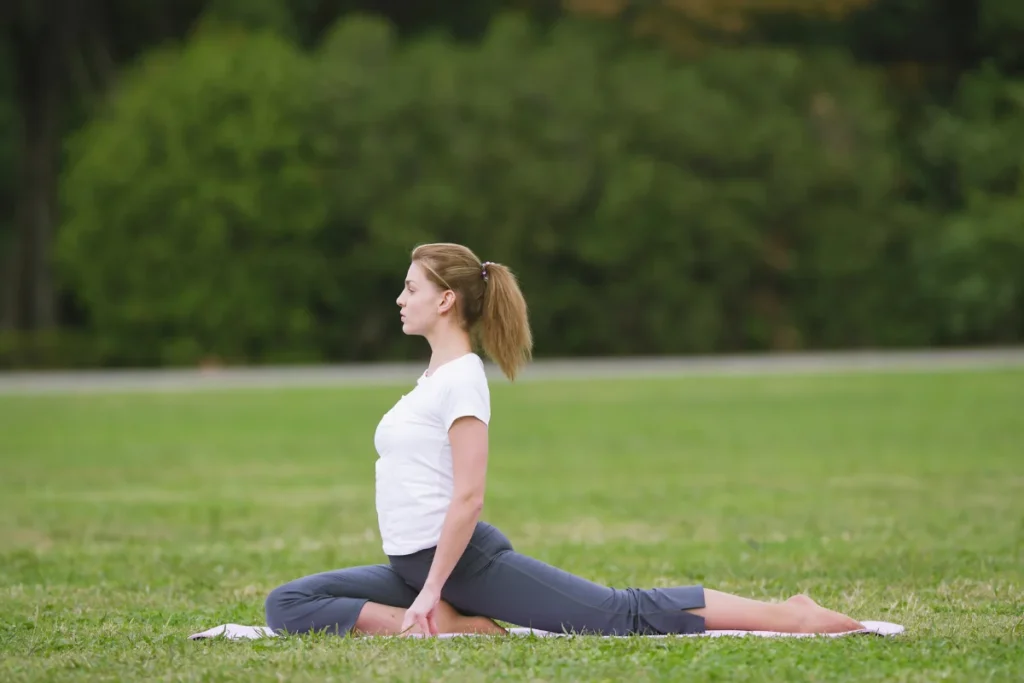
No other poses are as directly related to the hip rotators as Pigeon. With one leg bent forward the other leg is held farther back and the hip in the front is spread out with gradual, sustained pressure.
Pigeon Pose is a super key position for people who participate in sport activities that involve turning sideways, such as soccer, basketball, tennis, etc., where the hip rotators have to take repeated turns. Hold each for 1-2 minutes. Taking it quickly will throw off the whole purpose of this pose, because it doesn’t release the tissue until the nervous system feels at ease.
3. Warrior II (Virabhadrasana II)

Warrior II is a strength activity that also stretches and loosens muscles. Front knee bent at a right angle, back leg straight and on floor, arms out at shoulder height to opposite sides.
This pose works to strengthen the quadriceps and glutes, as well as open the hips and groin, which is helpful for sprinters, skaters, and anyone whose sport requires the athlete to have a wide, strong base. Sustain for 5 breaths on each side.
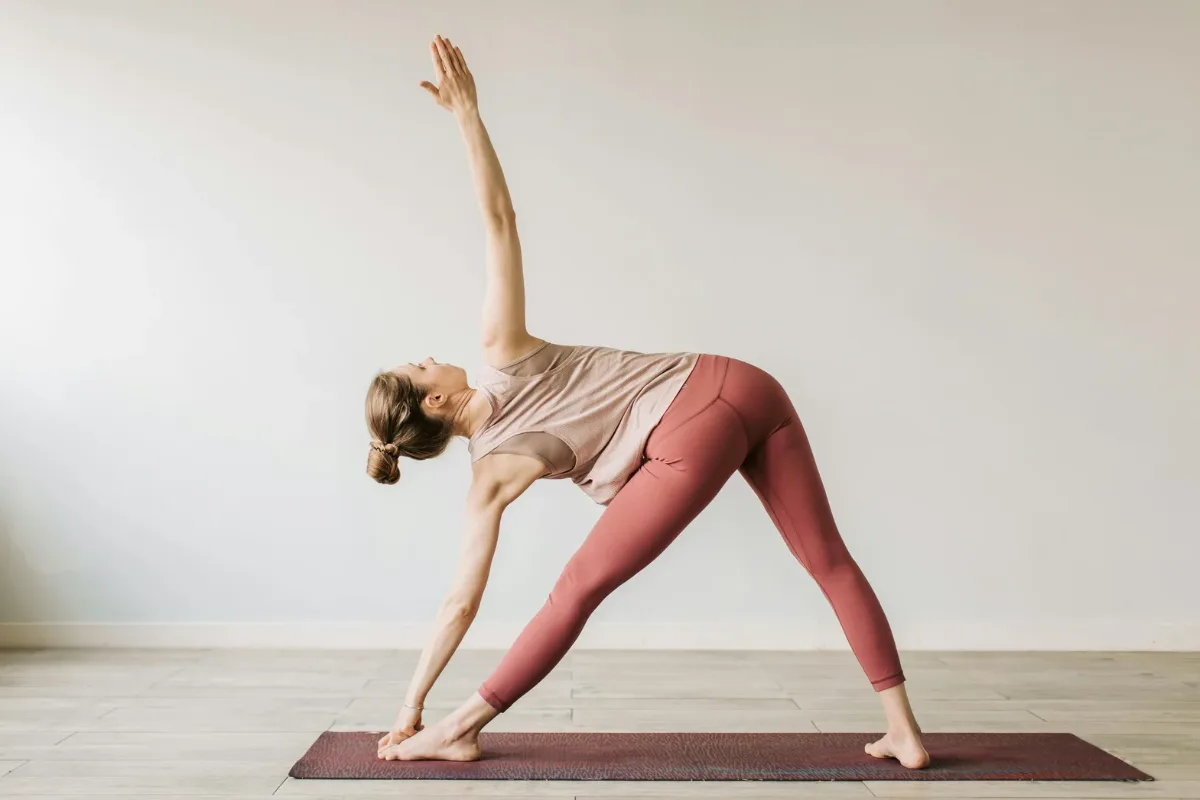
4. Triangle Pose (Trikonasana)

Triangle Pose stretches the hamstrings, hips and the often neglected side body in one pose. Front leg remains straight, torso dips to the side over front leg and one hand pushes outward toward the floor or shin, while the other reaches upward.
Athletes who are rotational (golfers, throwers, swimmers) have a chronic tightness around the lateral trunk. It’s an issue Triangle Pose tackles head-on, and one that is a problem in many less-specific side-bend poses because the lower back is compressed.
5. Bridge Pose (Setu Bandhasana)

Bridge Pose will help firm up your glutes and hamstrings and open up your chest and hip flexors, counteracting the forward hunch created by cycling, rowing, and desk work are all work related training exercises.
On your back with knees bent, squeeze feet together and raise hips. Hold for 5-10 breaths and then lower slowly and controlled. The pose also effects the posterior chain in a complimentary manner as it does not duplicate the squat or deadlift training.
6. Camel Pose (Ustrasana)

Camel Pose is a deep backbend that stretches the chest, shoulders and hip flexors all at once. Sitting on the floor (kneel), put hands on lower back or bottom of the feet, raise the chest to the ceiling.
This pose is one of the most effective poses to oppose forward-rounded positioning that is caused by activities such as cycling, rowing, and weightlifting. Camel Pose should be performed slowly — the backbend is strong, and its athletes should hold the lower back with their hands and not try to grasp the heels at once.
7. Low Lunge (Anjaneyasana)

Low lunge stretches the hip flexors (the psoas in particular) – a hip flexing muscle group that is shortened by sitting, cycling and running. Step one foot forward, lower back knee to floor and press hips forward.
This is one of the few poses which directly target the psoas which is a muscle at the heart of sprinting mechanics and is hardly incorporated into regular mobility workouts. Press for 1 minute on each side.
8. Cat-Cow (Marjaryasana-Bitilasana)

Cat-Cow to flex and extend the spine in a slow controlled sequence. When done on hands & knees, the spine arches as you breathe in, and rounds as you breathe out.
The pose is good for relieving the spine of the strain it suffers from the sport of repetitive sport as well as cycling or rowing, also it is a good warm up exercise before heavier sports or training. 5-10 rounds, in time with breath, is all that is needed.
9. Child’s Pose (Balasana)

Child’s Pose is a resting position — recovery is as important as output in an athlete’s program. Sit down with your knees, sit back on your heels and bring the torso forward with the arms out.
This position stretches the spine, hips and shoulders and helps reduce the heart rate, which makes it a natural ending to any workout. There is no set time for how long it should be held and it varies from person to person depending on the athlete.
10. Reclining Spinal Twist (Supta Matsyendrasana)

The Reclining Spinal Twist is a variation of the reclining twist that turns the spine in an upright position without lifting the shoulders (this will be more comfortable than the reclining twist without releasing tension in the lower back and obliques). Keep body on back, bring one knee across body and stretch arms out to sides.
Weaving this pose into the end of your rotational sports – GOLF, TENNIS, BASEBALL – routine is especially beneficial since the spine takes repeated one-directional torque during these activities. Hold for 1 minute on each side, breathing into the stretch, not against it.
Why yoga belongs in an athlete’s training plan
Strength Training = Capacity Development. Yoga restores range. An athlete working hard, without attention to mobility, will end up with restriction — and without attention to mobility, restriction will become injury.
The ten above poses are not a substitute for conditioning. They complement it and were selected to target the muscles that might get overused in sport-specific training and under-exercised in most other forms of training. A 20-minute session 3 or 4 times a week will be enough to be able to see the improvement in recovery and range of motion within a month.
Those who desire to dive deeper into the teachings of yoga beyond individual postures explore further, such as enrolling in a yoga school to study sequencing and anatomy in detail, or taking a 200 hour yoga teacher training to develop a comprehensive, systematic understanding of the working interplay of breath, alignment and recovery. While not required to enjoy the above poses, both go deeper into the practice for athletes who want to have longevity in their sport.
Begin with three exercises that relate to your sport’s needs. Pour in the remaining, little by little. You will know by the way the body moves and how it responds to the poses, which ones are more important.
Frequently Asked Questions
How often should athletes practice yoga?
Most athletes only need 2-4 sessions per week. Those who have chronic tightness or have suffered an injury will find additional benefit with daily practice, however it is consistency that counts, not frequency.
Can yoga replace a warm-up or cool-down routine?
Yoga is great for cool down because you can do some poses such as Child’s Pose and Cat-Cow to reduce your heart rate and restore range of movement after training. Dynamic movement is more likely to be effective for a warm up than static holds, so try to reserve deep stretches such as Pigeon and Camel for after the activity.
Is yoga safe for athletes recovering from injury?
The poses listed below are low-impact and safe to practice while rehabilitating, but athletes are advised to check with their physical therapist or their sports medicine professional before using yoga with an active injury, especially in exercises that involve deep hip and/or spinal flexion.
How long does it take to see results from yoga for athletes?
It takes the consistent practice for most athletes to see an improvement in their flexibility and decreased soreness, which is around 2-4 weeks. Hip or shoulder ROM changes will usually take 6-8 weeks to become apparent.
Do athletes need special equipment to start practicing yoga?
The only necessary item is a yoga mat. To get into poses like Triangle Pose or Low Lunge when flexibility is limited, blocks and straps can be used to help your athlete maintain good form.


