

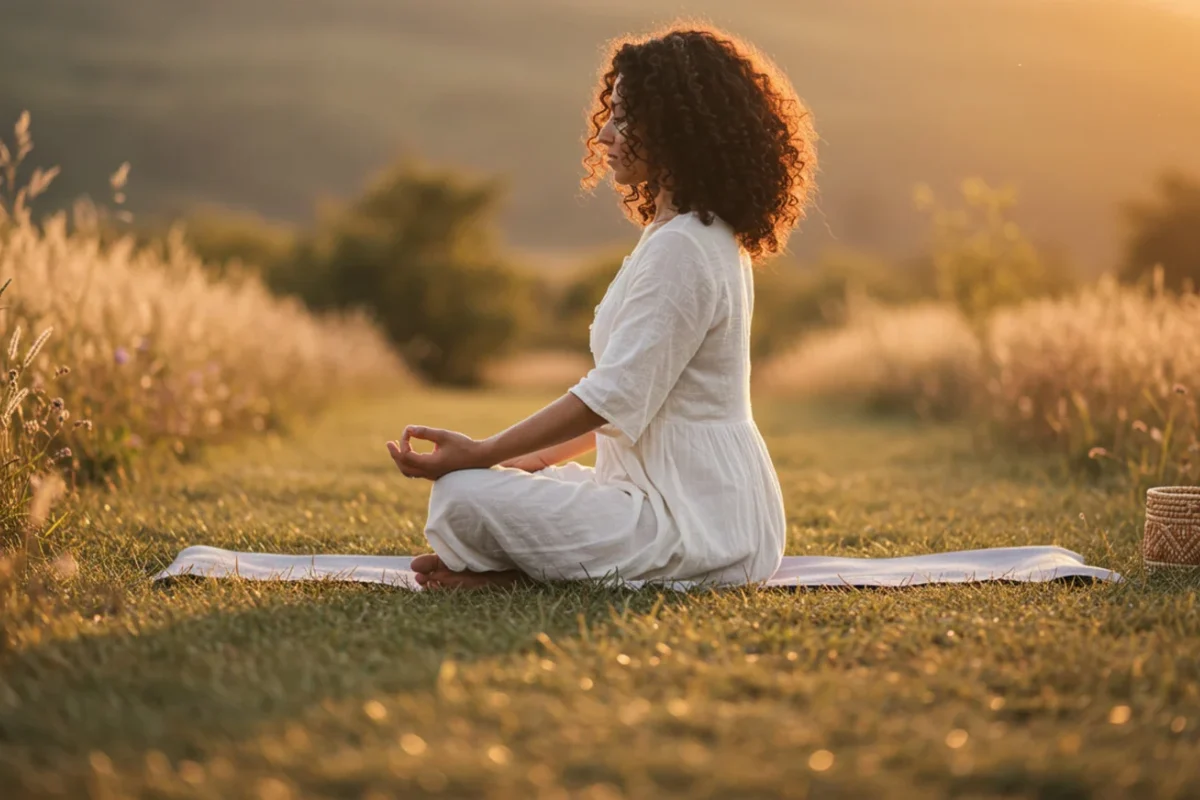
Yoga practices in this context, are designed to relax the busy mind and soothe the nervous system and cause physical and mental relaxation. The practices that are most helpful are pranayama (breathwork), meditation, yoga nidra, restorative yoga, mindful movement (asana), and trataka (candle-gazing concentration). Each work on mental chatter in a different way – with breath, stillness, deep rest, gentle posture, moving awareness or focused gaze.
The racing mind is not a willpower type of mind. It is hard to motivate yourself to “just relax” because mental chatter is more than a thought pattern, it is a physiological state. Yoga is what willpower doesn’t have; a direct line to the nervous system via breath, posture and attention.
Its importance lies in the scenario where the mind is perpetually busy, sleeplessness or a low-volume of anxiety sustained in the hectic timetable allotted. Yoga for the brain exercise isn’t about having a clear mind; it’s about bringing this nervous system into the right balance at will. The following list of six practices is ordered from the least complicated to the most complicated: Breathwork is the easiest and can be practiced anywhere; concentration practice is more advanced and requires dedicated attention cultivated over time; and the final two practices, final and difficult calm abiding, are still more advanced due to the difficulty of the task. They all describe themselves, why they help a busy brain relax and how to get started.
All yoga brain exercises can be taught, but there is much more to know about each exercise than can be explained in a blog post. A yoga teacher training course will teach you the physiology and sequencing of each exercise.
What is pranayama and how does it calm a busy brain?
Pranayama refers to yogic breath control science, the practice of yoga that involves regulating the breath, “prana” means life force, “ayama” means extension or control. It helps to relax an overactive mind by directly impacting the autonomic nervous system that controls fight-or-flight and rest-and-digest.
Prolonged, slow breathing stimulates the parasympathetic system, which is the system that governs calm. A racing mind is often accompanied with shallow rapid breathing. Breathing slowly and deeply communicates to the brain it is safe to stand down.
The initial sequence is very easy:
- You should sit as if you are straight, either in a chair or sitting cross-legged.
- Breathe in through your nose, to a count of 4, filling your belly first, then your chest.
- Maintain for a total of 4 counts.
- Exhale on a count of 6, longer than the inhale.
- Repeat this 5-10 times (about 2-3 minutes total).
Meditation teachers, military personnel, and even everyone in between now uses this form of ‘box breathing’ which happens when the hold is the same as the inhale and the exhale time, to help cope with acute stress. Consider practicing as your morning yoga brain exercise before a stressful meeting.
Check Out Our Yoga Teacher Training in Rishikesh
How does meditation quiet mental chatter?
Meditation involves focussing the mind, focusing on the breath and the mantra (or on a sensation in the body) again and again. Rather than removing thoughts, it helps to reduce the mental noises, by adjusting the relationship with thoughts.
A “Busy Brain” makes each thought seem important. Meditation is an exercise in paying attention to a thought, releasing it and then coming back to a focus point without engaging in the narrative. With time, this develops what is known as meta-awareness, or awareness of the mental state without being immersed in it.
The first step to a simple mindfulness exercise:
- Pick an anchor (breath is a good one to start with).
- Be silent for 5 minutes in a quiet place, with your eyes closed or just gliding downward.
- Be aware of when the mind is not on point, without judging yourself.
- Bring the attention back to the breath the next time you find you have wandered off.
- Ramp-up the time slowly, 1 minute, 2 minutes, 3 minutes, etc. per week.
In this case, it’s consistency that’s more important than length of time. 5 minutes a day is more effective than 30 minutes a month.
What is yoga nidra and why does it work for racing thoughts?
Yoga Nidra, which can be described as “yogic sleep,” is a form of meditation in which the practitioner is lying on the floor and the practice moves him between the states of waking and sleeping. It’s perfect for racing thoughts since it doesn’t ask you to direct your thoughts, it simply asks you to imagine certain scenarios.It’s great for racing thoughts because it doesn’t require you to control your thoughts, it asks you to immerse yourself in a body scan and visualization exercise.
Yoga nidra is a passive exercise in terms of the exercise of controlling the mind’s wandering thoughts, as opposed to meditation in a seated posture. This is a structure that allows an overactive mind less room to get lost in its own thoughts since you are not creating the thoughts yourself, but rather, following instructions.
For practising yoga nidra:
- Spend some time relaxing in Savasana (the final position), with a blanket or bolster for support.
- Make an intention that is short with one sentence, in the present tense.
- Listen to a guided recording that will take you through a body scan and visualization.
- Don’t get caught up judging the experience by just what you can see or feel; focus on the feeling words and not the analysis.
- The full practice (20 to 45 minutes) is available, but shorter versions (10 minutes) are also available.
This is one of the most beneficial yoga for the brain exercise ideas without having to be actively focused.
How does restorative yoga calm an overstimulated nervous system?
Restorative yoga incorporates supported, passive poses, which are held for long periods of time (5-20 minutes) to helps quiet an overstimulated nervous system. It does this using props (bolsters, blankets, blocks) that fully support the body, to take the weight of muscles out of the nervous system so that the nervous system is allowed to down shift without having to use muscles to take care of it.
Active yoga styles, such as vinyasa, keep the sympathetic nervous system somewhat stimulated via muscular engagement. Restorative yoga eliminates that one factor! The body is completely supported and no physical tasks are left to be done so the parasympathetic nervous system can be more fully realized than in standing and flowing poses.
A brief soothing progression:
- Set up supported child’s pose, with a bolster or stacked pillows under your torso.
- Hold for five minutes, breathing slowly and relaxing into the support.
- Move to legs up the wall position: place legs against a wall upright.
- With your eyes closed, hold this pose for 10 minutes.
- Come into supported savasana with a bolster underneath the knees for 5-10 minutes.
It’s especially helpful during the day when you are winding down and trying to sleep at night but your mind keeps going over all of the events from the day.
What is mindful movement and how does it differ from regular asana practice?
Mindful movement is a way of working with the asana (postures) and focuses on the sensation rather than achieving a certain shape. It’s not like a regular yogi session, but it takes the tempos very slow and considers each change of asana, not each pose, as part of the session.
Typical vinyasa flow is fast from post to post and can cause our mind to overthink the next movement. Here, mindful movement is the exact opposite, it takes things down a notch or two and keeps the brain focused on what is happening in the body instead of racing ahead to what comes next. This is one of those more approachable yoga brain exercises that is more applicable for those that cannot sit and remain still.
To practice in a mindful way:
- Select 3-4 basic poses — cat-cow, forward fold, gentle twist, mountain pose.
- Perform the movement half the normal speed, matching one complete breath per movement.
- As you move into the poses, pause for a complete breath cycle in between poses.
- Pay attention to the sensation in your body (where the stretch/tension or ease is) not the form.
- Always take 10 to 15 minutes to practice and make a mental exercise or moving meditation.
This works best for individuals who suffer from what we call “busy brain,” but still want to sit down to relax.
What is trataka and how does candle-gazing build focus?
Trataka is a concentration exercise focusing on a particular object, which is often a flame, instead of looking away from it and blinding yourself shall you blink during the period of concentration. It helps to develop concentration: the visual system is in constant search for new information, and can take a break from this and just settle on one fixed bit of information.
A busy brain is usually fueled by visual stimulation—screens, notifications and moving environments all require the brain to lose its focus. Trataka is the practice of the skill that is the opposite of rastrika, continuous and non-disturbed focus on one object. The one-pointedness (ekagrata in the yogics’ terms) is regarded as a basis for the deeper meditation practice.
To practice trataka:
- In a dark or dimly lit room, put a candle approximately 3 feet away and at the same height as your eyes.
- Look steadily into the flame, without blinking, for as long as comfortable, usually 30-60 seconds.
- Close your eyes and bring into your mind’s eye the after image of the flame.
- Pause and keep the visualization until it goes away.
- Repeat for 3-5 rounds over weeks, increasing the amount of time spent looking at the open eyes.
Unlike the other five practises that follow, slow progress is a part of Trataka.
Start with one practice, not all six
There is not enough room in a busy brain for six new habits, it takes only one practice, repeated over and over again. Choose the yoga brain exercise that works for your greatest challenge: breath for portability, yoga nidra for sitting meditation, or restorative yoga for evening time.
Build from there. After you feel comfortable with the first practice, add a second. Most practitioners have discovered that performing pranayama either in conjunction with meditation or yoga nidra fulfills a lot of the daily demands of the busy mind, while yoga nidra provides restful sleep support, and trataka can be used to build focus when that is needed.
Whether you are looking to teach, or simply wish to practice at a deeper level, a 200 hour yoga teacher training is the standard starting point to deepen both your practice and teaching, from a philosophical and physiological perspective.
Frequently Asked Questions
How long does it take to notice results from yoga brain exercises?
Many practitioners find that their mind starts to become quieter after 2-4 weeks of their daily practice, but individual sessions of pranayama or yoga nidra can provide on-the-spot calming effects.
Which yoga practice is best for anxiety specifically?
The fastest of pranayama practices for acute anxiety is extended breaths with longer exhale, this goes straight to the parasympathetic nervous system in a matter of only a few minutes. Breathwork combined with meditation is effective for sustained anxiety management and is often more effective.
Do I need special equipment to start these practices?
All that is needed for pranayama, meditation, mindful movement is the mind. Yoga benefits are enhanced by props such as bolsters and blankets and trataka is practiced using only a candle.
Can beginners practice trataka safely?
Yes, people can safely practice trataka as a beginner, by beginning with short gazing times, usually 30 seconds, and avoiding the practice if they have certain eye problems (such as glaucoma) without consulting a doctor first.
What’s the difference between yoga nidra and regular sleep?
During yoga nidra, the person remains conscious and aware between being awake and being asleep, whereas normal sleep is when they are completely unaware (asleep). That’s why yoga nidra can provide some of the restorative benefits of sleeping in a shorter, guided format.


